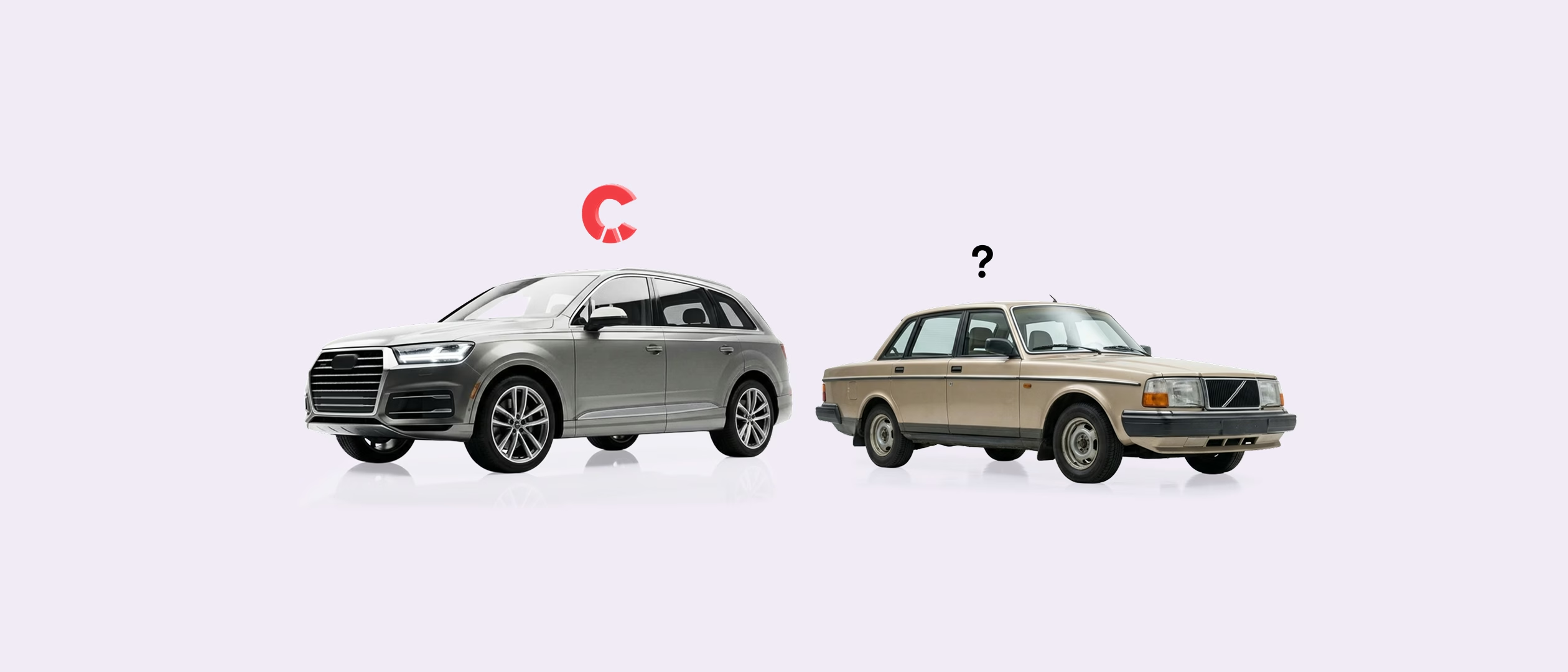
CPO (Certified Pre-Owned) is a manufacturer-backed program offered through brand-specific dealer networks, usually limited to vehicles under 4-6 years old and 80-120,000 km. Clutch Certified is independent of any manufacturer, applies to every vehicle Clutch sells, and includes a 10-day money-back return window. Most CPO programs offer at most a short exchange privilege, swapping into another vehicle from the same dealer’s stock, rather than your money back.
Key Takeaways
- Manufacturer CPO is brand-specific. Clutch Certified is brand-agnostic and applies to every car we sell.
- CPO carries a real price premium (roughly $1,500 on mainstream brands to $5,000 on luxury, per the Automobile Protection Association); Clutch Certified is included in the price.
- CPO usually offers an exchange privilege at most, not your money back. Every Clutch Certified purchase includes a 10-day no-questions money-back return.
- CPO inspections vary widely (roughly 100 to 170 points depending on the brand). Clutch Certified runs the same 210-point standard on every vehicle.
- For most Canadian used-car buyers, Clutch Certified is the better fit. CPO mostly makes sense for recent-model luxury where extended manufacturer warranty length is the deciding factor.
What is Certified Pre-Owned?
Certified Pre-Owned (CPO) is a manufacturer-backed program that lets dealerships sell a slightly more expensive, more thoroughly inspected version of their used inventory. Each manufacturer (Toyota, Honda, BMW, etc.) sets its own inspection checklist, eligibility rules, and warranty terms, then licenses dealers in its network to sell certified versions of their stock under the program.
The shared traits across most CPO programs:
- Brand-specific. Toyota CPO comes from Toyota dealers, not Honda dealers.
- Age and mileage limits. Usually 4-6 years and 80,000-120,000 km.
- Manufacturer warranty extension. Often around two years; the APA cites 2 years/40,000 km as a typical CPO term.
- Inspection points vary. Checklists run from about 100 to 170 points depending on the brand: Honda Canada’s program uses a 100-point inspection, while Toyota Canada’s runs 160 points.
- Price premium. About $1,500-$2,000 on mainstream brands and up to $5,000 on luxury vehicles over the same vehicle non-CPO, per the Automobile Protection Association.
What is Clutch Certified?
Clutch Certified is the standard every used vehicle on clutch.ca has to meet before being sold. It's run by Clutch directly, not by any manufacturer. Every car gets the same 210-point inspection, full reconditioning, and a 10-day no-questions return policy. None of those are optional add-ons.
The shared traits with CPO are limited but real: both apply a quality standard above non-certified used cars. The bigger differences are scope and structure:
- Brand-agnostic. A Honda, BMW, or Toyota all go through the same Clutch Certified standard.
- No age or mileage caps. The standard applies to every vehicle Clutch sells.
- Includes a 10-day money-back return. Most CPO programs offer only a 7-to-30-day exchange within the same dealer’s stock, per the APA, and rarely a refund.
- Standardized 210-point inspection. Same checklist for every vehicle, not a brand-by-brand variation.
- No price premium. Clutch Certified is included in the listing price.
For the full breakdown of what Clutch Certified covers, see What is Clutch Certified?.
CPO vs Clutch Certified: side-by-side
The biggest differences come down to scope, inspection rigour, and post-sale protection. Manufacturer CPO is brand-specific and capped by age and mileage. Clutch Certified applies to every car we sell, runs the same 210-point inspection on each one, and is the only program of the two that includes a 10-day return window.
[Table embedded below.]
The differences that matter most depend on what you're buying. For older vehicles or any non-luxury brand, CPO's age caps and price premium tend to outweigh its longer manufacturer warranty. For recent-model luxury where extended manufacturer coverage genuinely matters, the calculus can flip. The next two sections cover both scenarios.
"Most CPO inspections are 150-170 points. Ours is 210, with the same standard across every make and model. CPO inspections are pass/fail. We identify and disclose damage within standard so the buyer knows what they're getting," says Dusan Ramnjanc, GM of Ontario Production at Clutch.
When is Clutch Certified the better choice?
For most Canadian used-car buyers, Clutch Certified is the more practical option. It applies to every vehicle Clutch sells, doesn't cap eligibility by age or mileage, doesn't add a price premium, and is the only program of the two that includes a no-questions return window.
Specifically, Clutch Certified is the better fit when:
- You're shopping older vehicles. CPO programs typically don't cover anything past 6 years or 120,000 km. The Clutch Certified standard applies regardless of age or mileage, so a 7-year-old Honda gets the same 210-point inspection as a 2-year-old one.
- You don't want to pay a CPO premium. Manufacturer CPO adds roughly $1,500 to $5,000 to the sticker depending on the class of vehicle. Clutch Certified is built into the listed price, no extra fee.
- You want the option to return the car. A CPO car comes with a longer manufacturer warranty, but if the car turns out not to fit your life, your options are usually limited to exchanging it for another vehicle at the same dealer. Every Clutch Certified vehicle includes a 10-day no-questions return window.
- You're cross-shopping brands. A CPO program locks you to one manufacturer's network. Clutch Certified applies to every brand we sell, so a Toyota, a Mazda, and a Hyundai are all evaluated against the same standard.
- You'd rather buy online than visit a dealer. Clutch handles the inspection, reconditioning, paperwork, and delivery without requiring an in-person dealer visit. CPO programs run through brand dealerships by design.
Most buyers fit into at least one of these scenarios. Many fit several.
When might CPO still make sense?
There are still scenarios where manufacturer CPO is the better pick. They're narrow but real:
- Recent-model luxury where the warranty length is the deciding factor. A CPO BMW or Mercedes-Benz purchase often comes with 2-4 years of bumper-to-bumper manufacturer coverage on top of the original new-car warranty. If you're planning to keep the car for several years and the manufacturer's repair network is your main concern, that warranty depth may outweigh the price premium.
- Brand loyalists staying within one manufacturer's ecosystem. If you've bought every Toyota new from the same dealer for the last decade and the relationship is part of how you make car decisions, CPO fits that pattern. You give up the cross-brand comparison, but you keep the dealer relationship.
You want manufacturer promotional financing. CPO programs often carry lower interest rates than market used-car loans, which matters most at luxury price points. On an expensive vehicle, the rate saving can offset a meaningful share of the CPO premium.
For other buyers, the trade-offs usually run the other way.
Does CPO mean a car is in perfect condition?
No. CPO certifies that a car has met the manufacturer's specific inspection bar at the time of sale, not that the car is free of issues or guaranteed to outperform any other used vehicle. A CPO label says the car passed a checklist of roughly 100 to 170 points set by the brand. It doesn't override the brand's underlying reliability profile.
That distinction matters more than buyers usually expect. In our reliability data covering more than 100,000 inspected vehicles, a Honda at 120,000 km outperforms a BMW at 60,000 km on average inspection failure rate. The CPO label on the BMW doesn't change that, because CPO works against the manufacturer's own benchmarks, not against an independent quality bar.
Brand reliability still drives the long-term picture. For the full breakdown of how 25 brands rank, see the 2026 Clutch Certified Reliability Report.
How much does a CPO car actually cost?
A mainstream-brand CPO car typically lists for about $1,500 to $2,000 more than the same vehicle sold non-CPO, and a luxury CPO can run up to $5,000 more, according to the Automobile Protection Association. What you're paying for is mostly the extended manufacturer warranty, plus the dealer's slightly more thorough inspection and reconditioning compared to their standard used-car prep.
Whether that premium pays off depends on two factors: how long you plan to keep the car, and the brand's underlying reliability. For a brand that runs into expensive repairs at average mileages, the extended warranty has real protective value. For a brand that holds up well long after the original new-car warranty expires, the CPO premium is largely paying for coverage you may never use.
Total cost of ownership is the better lens. Brand-level reliability data shows ongoing maintenance and repair costs vary far more by brand than by CPO status. A non-CPO Toyota will usually cost less to own across five years than a CPO Audi, regardless of warranty terms.
Browse Clutch Certified inventory
Every Clutch vehicle includes the 210-point inspection, full reconditioning, and a 10-day return policy. No price premium, no brand restrictions, no age caps.
FAQs About Clutch Certified vs CPO
Is CPO worth the extra money?

For most buyers, no. CPO adds roughly $1,500 to $2,000 on mainstream brands and up to $5,000 on luxury vehicles, primarily covering an extended manufacturer warranty. If the car's brand has strong long-term reliability, you may never use that warranty. If the brand needs more repair work over time, the warranty has real value. Total cost of ownership tends to depend more on brand reliability than CPO status.
What's the difference between CPO and certified used?
"Certified used" is sometimes used loosely. Manufacturer Certified Pre-Owned (CPO) is a brand-backed program with specific inspection, eligibility, and warranty rules. Other certifications (like Clutch Certified) are independent quality standards run by retailers, with their own inspection process and protections. Always check who runs the program and what it actually includes.
Can I return a CPO car?
Usually you can exchange it, not return it. Most automaker CPO programs include a 7-to-30-day exchange privilege that lets you swap into another vehicle from the same dealer's stock; a money-back return is rare. Every Clutch Certified vehicle includes a 10-day no-questions money-back return.
Is Clutch Certified considered CPO?
Technically no. CPO is a manufacturer-issued certification. Clutch Certified is an independent retailer-issued certification. Both apply a quality bar above non-certified used cars. The biggest functional differences: Clutch Certified is brand-agnostic, doesn't cap eligibility by age or mileage, and includes a 10-day return policy that CPO programs almost never offer.
What's the cheapest way to buy a reliable used car?
The lowest sticker prices are usually private sales, but they come with no inspection guarantee and no return policy. The best balance of price and protection for most buyers is a Clutch Certified vehicle: no CPO premium, but every car gets a 210-point inspection, full reconditioning, a 10-day money-back return window, and optional Protection Plans if you want longer coverage.
.avif)